Male stacks, Female gaps
Exploring Project Progress and Wilhelmina Barns-Graham at Abergavenny Library

This month we had a last minute room change at the library and so we were in the Mayor's Parlour instead. Great space, though I am looking forward to January when we’ll gather back on the Mezzanine. What I particularly like about the mezzanine is its openness and how library users can stumble upon the sessions and listen in if they want.
We now have colour posters up for the sessions in the library and around town and I am delighted by the enthusiastic responses finding their way to my inbox.
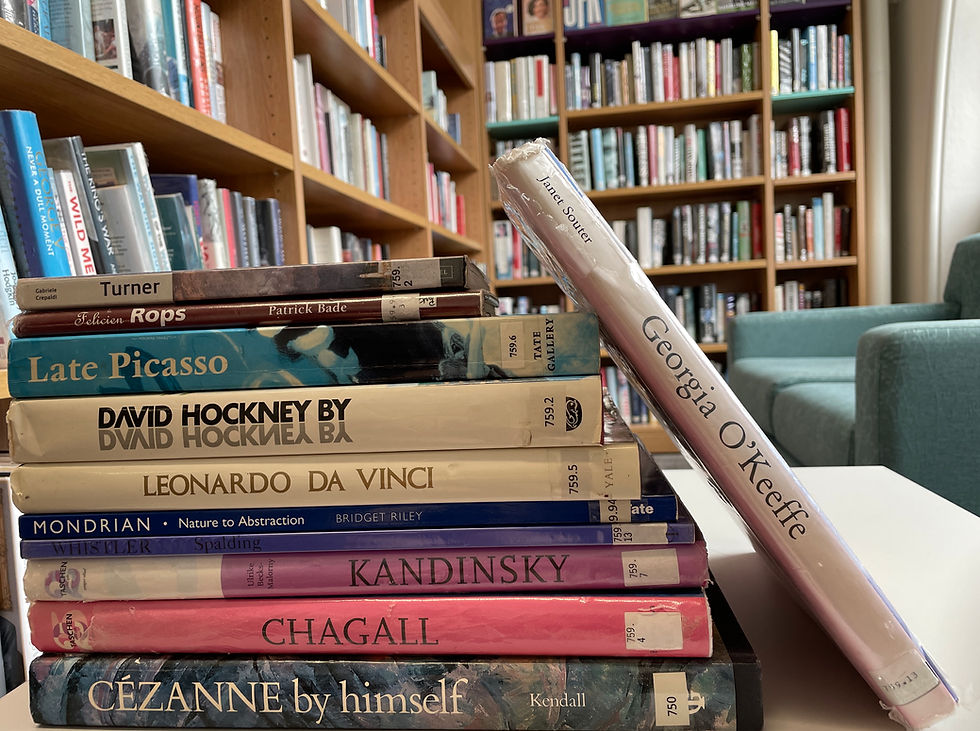
In preparation for November's session I spent time in the library double-checking my artist book count for Abergavenny and found an extra twelve books on individual artists in the junior section, though there were none on female artists. With this list of books I created a visual representation of the stock in orange and green card squares for each book. Green for books on artist-women and orange for artist-men. I arranged it in a grid and it very nicely set the scene to demonstrate a set up Barns-Graham used in her Squares series of paintings where she arranged cards in a grid, used her foot to disrupt them and then used the resulting arrangement as inspiration for paintings.


During my illustrated talk on Wilhelmina Barns-Graham I had comments and questions -
Liz -
IF YOU CAN’T SEE IT
YOU CAN’T BE IT
Ed -
Could you use the information you are collecting as a loose proxy (or commentary) to the wider society of the time or period.
By having information about books in libraries from non-UK countries - is there such a disparity globally or just in Western states such as UK and America or e.g. in Italy during their times where they were showing a more balanced equality.
Of course it could also be a little bit of the “vegetables in the supermarket” problem - people just pick up what they know and until they’re educated on what is new, they keep with what they already recognise.
How many books about women artists are there?
Lots to consider! I think the range of artist monographs in UK public libraries reflects the tastes and aspirations of the people choosing the books and what type of art and artists are accepted and popular in the period they worked in. The artists we can trace now from past eras could be a commentary on the society of the era. I believe the disparity in books in libraries is probably global. In Italy during the Baroque period there were prominent female artists such as Artemisia Gentileschi, Sofinisba Anguissola and Lavinia Fontana, but proportionally there were nowhere near 50:50 female to male professional artists.
I think what we have now is a “vegetables in the supermarket” problem - that people pick up what they know until they know about what else is available by venturing further - perhaps by sourcing vegetables from other places, I would say also by growing your own, but that’s the name of a friends project ‘grow you own artist’!
There were more questions that I can’t remember because I was answering them! I would love a notetaker!
I’m shaping the next 6 talks and trying to choose six of the following artists due to the quality of their work and that they cover a wide range of media: Ana Mendieta, Rosa Bonheur, Käthe Kollwitz, Niki de Saint Phalle, Faith Ringgold, Lee Miller, Linder and Hannah Höch.
I have chosen the first collage artist to talk about in January, Hannah Höch. Do join us on the library Mezzanine on Saturday January 24th 11am until noon.


Comments