Reflecting on the Hannah Höch Talk in January: Questions, Donations, and Data
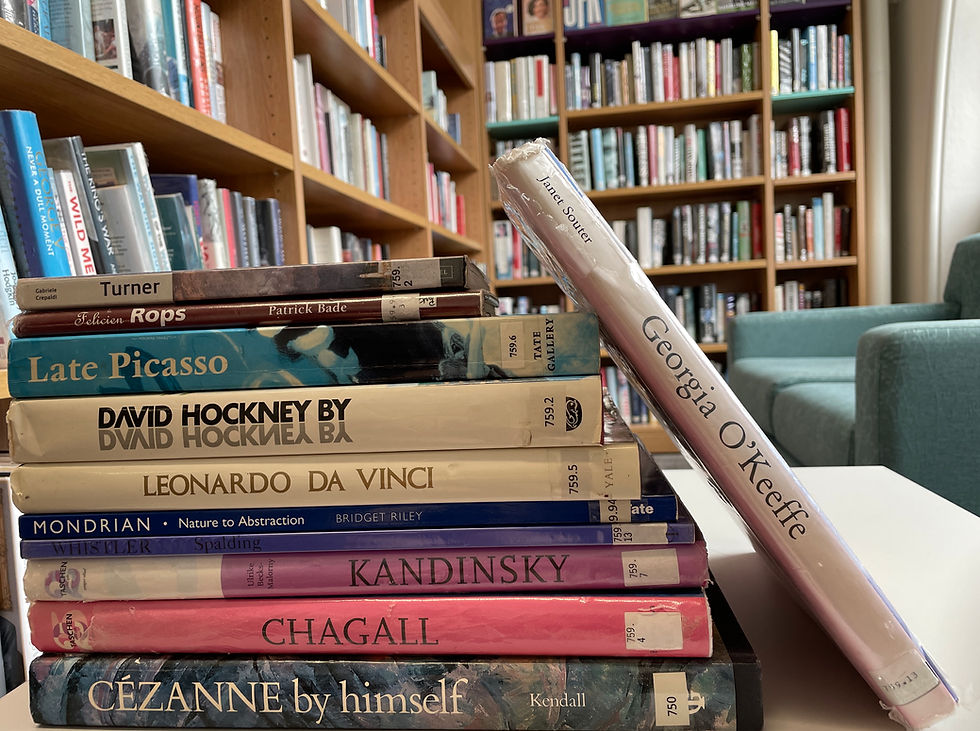
Last month’s talk on Hannah Höch opened up some fascinating conversations about the Male Stacks, Female Gaps project as well as about the artist and her work. Do get in touch via email with me at wynnepaton@outlook.com or via instagram @wynnepaton if you would like links to free online resources I used while preparing for the talk and I’ll share them with you. The questions from the audience pushed me to articulate the methodology behind the work, and I wanted to share some of those exchanges here.
Several people asked why I'm only counting monographs - books dedicated to individual artists - rather than including publications featuring multiple artists. It's a fair question, and the answer has both practical and conceptual dimensions. A monograph represents a particular kind of cultural recognition, a statement from publishers and the art world that an artist's work merits sustained, in-depth examination. Including books on two or three artists would muddy the waters: how do you count a book on two artists? As half a book each? It becomes impossible to make meaningful comparisons. There's also something revealing about what we privilege culturally. Why do we value the study of individual achievement over collaboration? Why is a single name on a spine so much more visible on a library shelf than multiple names together?
The practicalities of data collection came up repeatedly. Someone suggested using barcodes to log books, which could work if we know which artist and library it relates to, though barcodes don't always scan reliably. I have been working with lecturer and researcher Seán Roberts at Cardiff University School of English, Communication and Philosophy who is collaborating with me on this project, developing a Book scanning app that can simplify the data collection and analysis process for this project. The book scanning app allows for corrections before saving to the database, which keeps the process manageable. But the bigger question is scale: I need volunteers. Ambassadors to promote the project, and book loggers willing to visit libraries across the UK to collect data. If you're interested in either role - or in giving local talks about female artists you'd like to see in your own library - please get in touch.
The conversation turned to action: what can we actually do about these gaps? The answer is surprisingly straightforward. We can donate books on female artists to libraries - with the crucial caveat that donations must be female artists only. Donating books on both male and female artists would simply widen the existing imbalance. I'm happy to facilitate donations and add a stamp linking them to the project. We could also approach galleries representing female artists to request donations. And perhaps most directly: we can ask our libraries to acquire specific titles. They want to know what their communities need.
Someone suggested creating a collage billboard featuring the female artists I'm highlighting, which would be wonderful for visibility. The copyright complexities give me pause for thought, but I'd love to see volunteers create work independently and contribute it to the project. The challenge, as always, is ensuring proper compensation for that labour.
What struck me most about the session was the enthusiasm. The librarians I've spoken to - in Abergavenny, Swansea, and at Victoria library in London - have all been supportive. People want to help. The question of what proportion of published artist monographs actually feature female artists remains something we're investigating, and it's methodologically complex. But the project is moving forward, one scanned book and one conversation at a time.

Back in December, I visited the Paula Rego exhibition at Christea Roberts Gallery in London. While there, I got talking with one of the Associate Directors, who very kindly donated a catalogue from the show for the project. This became our first addition to Abergavenny Library's collection since the project's inception - a small but significant milestone.
After January's talk, I presented the book to the library. Each donated book is stamped with the project title, the donor's name, and the receiving library, creating a visible record of how these collections grow through collective action.

Looking ahead, I'll be giving an illustrated talk on 28th February from 11am to noon about Niki de Saint Phalle - French sculptor, painter, filmmaker, and author of vibrantly illustrated books. If you'd like to join, do come along and join the conversation at Abergavenny Library Mezzanine, Town Hall, Cross Street, Abergavenny, NP7 5EU.


Comments